

Welcome to another Thursday UNFILTERED blog post, the only blog that wants to know when waiters and waitresses started responding to everything with “of course,” as if they were asked whether water is wet?
Thanks to all of you who took the time to listen to the conference message featured in last Thursday’s article, a message that addresses four common problems most Christians face today, your responses are greatly appreciated.
Here’s a recent response that was sent the other day:
“Brother Frank, my wife gave me your message today which I heard from beginning to end. I myself preach and have served as a missionary, and I have never heard such powerful and insightful teaching. Thank you, brother.”
If you’re new to the email list or didn’t see last Thursday’s article, you can check it out here.
What Happens When We Stop Reading the Bible Wrong?
Shane J. Wood (Ph.D) – a Professor of New Testament – recently interviewed me on the subject of the Bible. Since you’re on my email list, you have a deep interest in the Scriptures and how to interact with them for maximum spiritual impact.
For this reason, I’m sharing the interview with you today. I believe you’ll find value in it since it covers ground I’ve never discussed before. Even if you have my new book, you’ll gain new insights from the interview.
If you’re at a computer, you might want to print it out also.
Enjoy!
Shane Wood: You describe your new book, The Untold Story of the New Testament Church: Revised and Expanded (2025), as “a cross between a narrative commentary and a Bible handbook.” How does studying the New Testament as a “story” inform the curious in a way not found in a traditional Bible reference work?
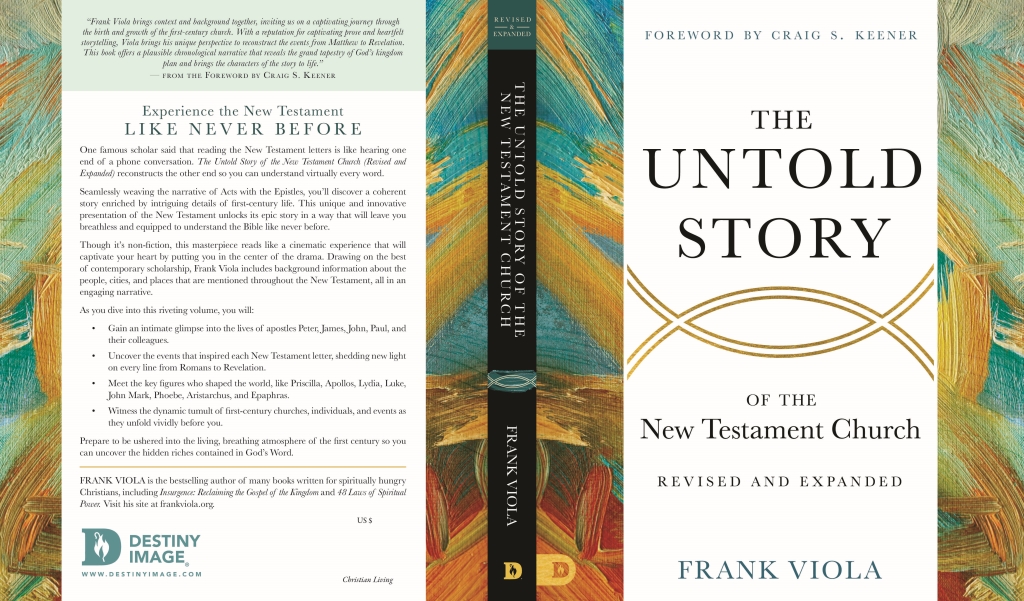
Frank Viola: Traditional Bible guides don’t give you the whole narrative in chronological order. Even chronological Bibles don’t give you the narrative. All they do is rearrange the books of the Bible (and they disagree with each other on the timeline).
By contrast, my book gives you the entire story in chronological order, but with all the details filled in. Let me expand that statement by way of illustration.
Luke gives us around the first 32 years of the early church’s life. But he doesn’t give us the whole story because:
- He compresses his entire narrative and leaves a great deal out. However, we have a lot of the information concerning what Luke left out in Paul’s epistles and in the book of James.
- Luke ends with Paul on house arrest in Rome. Paul wrote a number of his epistles after that time. The same is true for the letters of Jude, Hebrews, Peter, John, and the book of Revelation. They all came after the events recorded in Acts 28.
Consequently, my book puts the reader in the story, allowing them to watch it unfold chronologically. All the details that Luke leaves out of his narrative are filled in through the most up-to-date scholarship on first-century history as well as from the epistles.
The result is one high-octane, cohesive story that’s supported by the best scholarship in the world, with over 2,400 citations. It’s also been endorsed by 20 of the best scholars in the world, including the greatest New Testament scholar of our time—Craig Keener, who wrote the Foreword.
Some of the scholars who have endorsed the book are Darrell Bock, Joel B. Green, Michael Licona, Mark Strauss, Richard Horsley, David deSilva, Constantine Campbell, Paul Barnett, Clinton Arnold, Eckhard Schnabel, Jeffrey A. D. Weima, along with many others.
N.T. Wright was also helpful in reconstructing some of the events, and I cite some of our conversations in the notes.
The perspective the book provides to readers is far beyond what they will get in traditional Bible reference books. Those don’t give us The Story. They fail to provide the narrative. That’s precisely why I took on the Everest-like challenge to write the book.
Shane Wood: What is the most illuminating period of time (or event) for understanding the New Testament and God’s plan?
Frank Viola: I don’t think there is any single period of time that we can isolate as the “most illuminating.” That really depends on what part of the New Testament narrative a particular person is interested in.
For instance, if it’s the foundations of the Christian faith, it would be A.D. 30 to A.D. 34 which are covered in the early part of the book of Acts up to the dramatic conversion of Saul of Tarsus.
For me personally, I think the most fascinating period is from A.D. 49 to A.D. 63. That covers the time that Saul (Paul) of Tarsus is sent out with Barnabas from the church in Antioch to the Lord’s work of raising up kingdom communities.
They plant four churches in South Galatia. Paul’s long-standing enemy emerges, and Paul writes the letter to the Galatians to address his influence in the new churches he and Barnabas planted.
The Jerusalem council takes place and Paul and Silas head out to Greece and plant four new churches there.
Following that period, Paul writes 1 and 2 Thessalonians followed by 1 and 2 Corinthians. Then Paul heads to Ephesus to plant a church there that will influence the Roman province of Asia.
In Ephesus, he will train apostolic workers (church planters) to take his place (just as Jesus trained apostolic workers to take His place).
In short, Paul trained Christian workers the same way Jesus trained workers. Paul trained 9 while Jesus trained 12. And the training lasted about the same amount of time (around 3 years).
We see all of their names when the story is pieced together as I do in the book.
It’s all high drama. And The Story throws tremendous light on the epistles, including Paul’s. It also gives us insight into the unchanging ways of God, some of which are little known to many Christian leaders today.
Shane Wood: New editions can be just as difficult to construct as the first. What was your approach to revising and expanding your first edition of this book? What are the major differences between the editions?
Frank Viola: The new book is much more than a revised edition. It’s actually a brand new book. The reason why we put “revised and expanded” in the title is because I didn’t want to change the main title since it appears in some of my older works.
I’ve been researching for this book since 1998. I wanted to find out what really happened in Century One, and how the epistles fit together with the book of Acts in the timeline.
The questions I was asking were, “Where in Acts did Paul write his epistles?” “Who were the Galatians, how did they live, how many were there, who were their enemies, where was Paul when he wrote to them, what was he feeling and thinking, what provoked the letter?”
I brought those same questions to all 21 epistles of the New Testament.
The answers I discovered opened up an entire new world of reading and understanding the Bible. One that ignited my heart and caused me to understand virtually every word of each letter.
It also brought the names Paul mentions at the end of his epistles to life. I no longer saw them as “throw away greetings,” as many Christians do. Instead, they became major plot points in an unfolding drama.
Way back in 2005, I wrote my first draft from my research at the time. It was poorly written, incomplete, and most of the research wasn’t even in print yet. (We’re talking two decades ago!)
That was the first edition, which is extremely flawed. I consider it on a par with a high school research paper. Consequently, I tell people if they come across the old edition (with the ugly orange cover) to ignore it. And if they have a copy, throw it out.
Again, the new edition is a brand new work, five times larger than the old flawed version with the best research available to create a powerful and plausible reconstruction. One that has changed the game for many Bible teachers and pastors as well as Christians who love the word of God.
That’s been the testimonial of hundreds of people since the book released last year.
With respect to the differences, they are too numerous to delineate. The old version is like a tricycle where the new version is like a Rolls Royce. They don’t even share the same universe.
Shane Wood: In the process of writing your new book, what struck you? Was there an issue you changed your mind on since the first edition? Or maybe a new vantage that inspired you this time around?
Frank Viola: There are many, but what stood out the most was the identity of Paul’s thorn in the flesh. The new book has broken new ground on this much-debated issue.
For centuries, theologians, scholars, and bible interpreters have tried to explain what the thorn was.
Theories range from an eye disease, malaria, epilepsy, migraine headaches, to an ongoing temptation with lust.
If you read the New Testament like most Christians do, without The Story, without the chronological background, it’s not clear what the thorn is.
But if you read the narrative chronologically with all the details filled in, which my book does, it become profoundly clear what the thorn was—or more accurately—WHO the thorn was.
The book even has a gray box excursus that brings all the evidence together. It has once and for all solved the mystery. I’ve had the best scholars in the world review it. And their response was unanimous. “It’s the most plausible and likely reconstruction ever produced.”
Here’s an excerpt from Craig Keener’s Foreword.
“In The Untold Story of the New Testament Church, Frank Viola brings context and background together, inviting us on a captivating journey through the birth and growth of the first-century church. With a reputation for captivating prose and heartfelt storytelling, Viola brings his unique perspective to reconstruct the events from Matthew to Revelation.”
Shane Wood: Your book includes the story found in Luke’s Gospel and the Acts of the Apostles. What value do these works possess in reconstructing the historical account of the early church? What details must be supplemented with other New Testament texts?
Frank Viola: Luke’s works provide the main outline for The Story. The epistles fill in the details.
The New Testament letters don’t provide us with chronology. The letters of Paul, for instance, were not arranged sequentially, but by length. So my book brings it all together chronologically.
Without doing this kind of work of sequential reconstruction, we don’t have The Story. So we default to the “cut-and-paste” method of Bible reading and Bible study.
The “cut-and-paste” method finds its origins in the Protestant scholastics of the 16th to 18th centuries.
They practiced what is called systematic or topical theology (theologia systematica). The basic idea is that you can cut and paste verses from the Bible together on the same topic to create a doctrine or theology.
But that approach has created an approach to Scripture that ignores context and background. You can prove anything by taking verses out of context and lashing them together.
As the T shirt says, I can do all things through a verse taken out of context. That’s why we have over 40,000 denominations in the Protestant Christian world today, many of which are at war with each other.
Let me finish my rant by giving a short riff on New Testament 3.0.
My book is a contribution to what I call New Testament 3.0. This is a framework I created last year.
New Testament 1.0 was when the original Greek was translated into the language of the people.
First you had Jerome with his Latin Vulgate. Then you had Martin Luther with his German translation. Then you had Tyndale with his English translation.
Then New Testament 2.0 came along later. This is when Christians took the tools that classical historians use to analyze ancient documents and applied them to the New Testament.
So you had textual criticism, source criticism, redaction criticism, literary criticism, etc. It also identified the original meaning of Greek words.
That’s all good, but it’s not enough to unlock the New Testament. You can memorize the New Testament in Greek from Matthew to Revelation and still not understand what you’re reading.
That brings us to New Testament 3.0.
New Testament 3.0 builds on New Testament 1.0 and New Testament 2.0. But it puts the entire New Testament into a chronological narrative with all of the details filled in. That’s precisely what my book does.
Shane Wood: Your chapters are oriented not only in time but also in location, many containing a map of the area in which the events occurred. Why is it important to treat the geographical locations as an essential detail in the stories of the New Testament?
Frank Viola: I’ll use Paul of Tarsus as an example along with his travels (with Barnabas, Silas, Timothy, Titus, and the other workers Paul trained).
Understanding Paul’s geographical locations are essential for shedding light on The Story for several important reasons:
Historical and Cultural Context: The specific cities Paul visited weren’t just backdrops. Each had distinct cultures, religions, economic systems, and social structures that shaped how people received his message. Understanding whether Paul was writing to the Corinthians or the Ephesians explains the differently style and language he used in his epistles.
Verification and Credibility: The geographical specificity provides checkpoints for historical reliability. Luke’s detailed itineraries in Acts include verifiable details about local officials, travel routes, and city layouts that align with archaeological and historical evidence.
Understanding Paul’s Strategy: The locations reveal Paul’s apostolic approach. He targeted major urban centers along trade routes (Ephesus, Corinth, Thessalonica) where the gospel could spread naturally through existing networks of commerce and travel.
Interpreting His Letters: Knowing where communities were located helps us understand Paul’s specific advice in his epistles. His instructions weren’t abstract theology but responses to real situations in real places.
Corinth is an example. When Paul writes to the Corinthians about sexual immorality, food sacrificed to idols, and social divisions, these issues make much more sense when you know Corinth’s geography and culture:
Without knowing Paul was writing to believers living in Corinth specifically, his teachings might seem random. But with that geographical context, we see he’s addressing the particular moral challenges Christians faced in that seaport environment, challenges quite different from what believers faced in smaller towns like Berea.
Shane Wood: Chapter 5 is titled “The Hinge Pin of the Drama: Calvary.” How does the New Testament story “hinge” on the death and resurrection of Christ?
Frank Viola: The First Testament, what we call the “Old Testament,” all points to the climactic event of the death and resurrection of the Messiah. After the Gospels, the rest of the Second Testament (the “New Testament”) points back to it and explains it’s massive implications.
It’s the great hinge of the Bible and The Story. What happened on the cross was more than simply the forgiveness of sins. When we read the Gospels, we see the historical side of what Jesus endured in His death. He predicted His suffering and murder before it happened. And He promised it would be for the remission of sins.
The Gospels show us the horrendous brutality of the crucifixion. We meet all the players involved in the crucifixion. But when you look at Paul’s letters, which are based on the revelation that he received from the Holy Spirit, the apostle brings out the cosmic dimensions of the cross and the resurrection.
Through His death and resurrection, Jesus destroyed principalities and powers, He nullified the kingdom of darkness, He rendered Satan powerless over all who trust in Him (Christ), He gave His followers authority over the enemy and the kingdom of darkness.
By His cross, Jesus nuked the sin nature (the old man). He also torched the world system. In short, the cross and resurrection of Jesus undid all of the effects of the fall of humanity.
My book puts all of it together from the Gospels combined with the epistles, creating a full narrative. The resurrection of Jesus, which is the other side of the cross, is the birth of the new creation. And it dominates the New Testament story.
Shane Wood: Your final two chapters situate the end times along the same timeline that encompasses the historical events from A.D. 30—70. What is the benefit of understanding the events “yet to come” in light of those that have “already” happened?
Frank Viola: Because that’s where we all live today. We live in the “already” awaiting the fullness of the “not yet.” And we cannot understand what God is doing in the present and what He ultimately intends to do in the future without understanding The Story.
For this reason, the latter chapters deal with the big takeaways and practical implications of knowing the New Testament narrative. They also explain that we have before us a blank page. It’s the next chapter in church history that all of us are called to write.
If we learn The Story, what we’ll write upon that page will be very different than if we never learned it and we only understand the Bible in its current non-sequential arrangement through the lens of chapters and verses.
Learning The Story changes everything. And that’s why I took the time to write the book, which was a super heavy lift.
Shane Wood: If I were a pastor wanting to know more about the story of God, how can this book be used in sermon preparation? What is the benefit for a congregation when a New Testament passage is placed on a timeline of history?
Frank Viola: The benefit is transformation for yourself, which is critical for aiding transformation in those who listen to you speak.
Many pastors and Bible teachers are using the book. They are testifying that their congregations are being ignited to read the New Testament regularly. And they are being transformed by it, as their minds are being renewed to the full truth and understanding of God’s word in a fresh way.
Again, we can only be transformed by the word of God if you accurately understand it.
There are also bulk discounts for churches, fellowship, Bible studies, etc. on the book landing page.
Shane Wood: Despite most authors’ wishes, a book can only be so comprehensive. What portion or theme from this book would you like to develop further in the future?
Frank Viola: I have been developing and expanding the themes in the book for sometime now.
Here are two messages that I recently delivered at Restoration Movement conferences. Since you share that heritage (the Restoration Movement), your readers may be interested in listening to them:
A Collision of Temples: God’s Restoration Work Continues – delivered in Michigan
Encountering the Risen Christ: Then and Now – delivered in Mississippi
I’ve also been creating Master Classes on each of Paul’s epistles. They are made up of conferences messages I’ve delivered over the years in different places.
The Master Classes are deep dives into each Pauline letter, presenting it to the right brain as well as the left brain, hence the title “3D.”
The Master Classes that have been completed so far are:
Galatians in 3D: 20 conference messages.
1 Thessalonians in 3D: 36 conference messages.
2 Thessalonians in 3D: 15 conference messages.
1 Corinthians in 3D: over 20 conference messages
Ephesians in 3D: 36 conference messages
God willing, I plan to release a new Master Class for Paul’s other epistles in the future.
All the Master Classes are on The Deeper Christian Life Network.
In addition, some of my books expand certain parts of the story. For example:
Insurgence: Reclaiming the Gospel of the Kingdom focuses on the gospel of the kingdom throughout the biblical narrative.
God’s Favorite Place on Earth is the story of Jesus and His relationship to the little village of Bethany and its profound application to Christians today.
From Eternity to Here explores and expands the grand narrative of the Bible, which is God’s Eternal Purpose.
These books can be test-driven and accessed at frankviola.org/discography.

 4 Problems Christians Face (Do You Have Any?)
Leave a Reply